When most people think of Human Resources, they think of corporate handbooks, onboarding paperwork, and maybe an annual harassment training. But the original roots of HR in the United States were far more practical—and far more personal. In fact, the first formal Personnel department in the U.S. wasn’t born out of compliance checklists or leadership retreats.
It was born out of conflict.
The Strike That Changed Everything
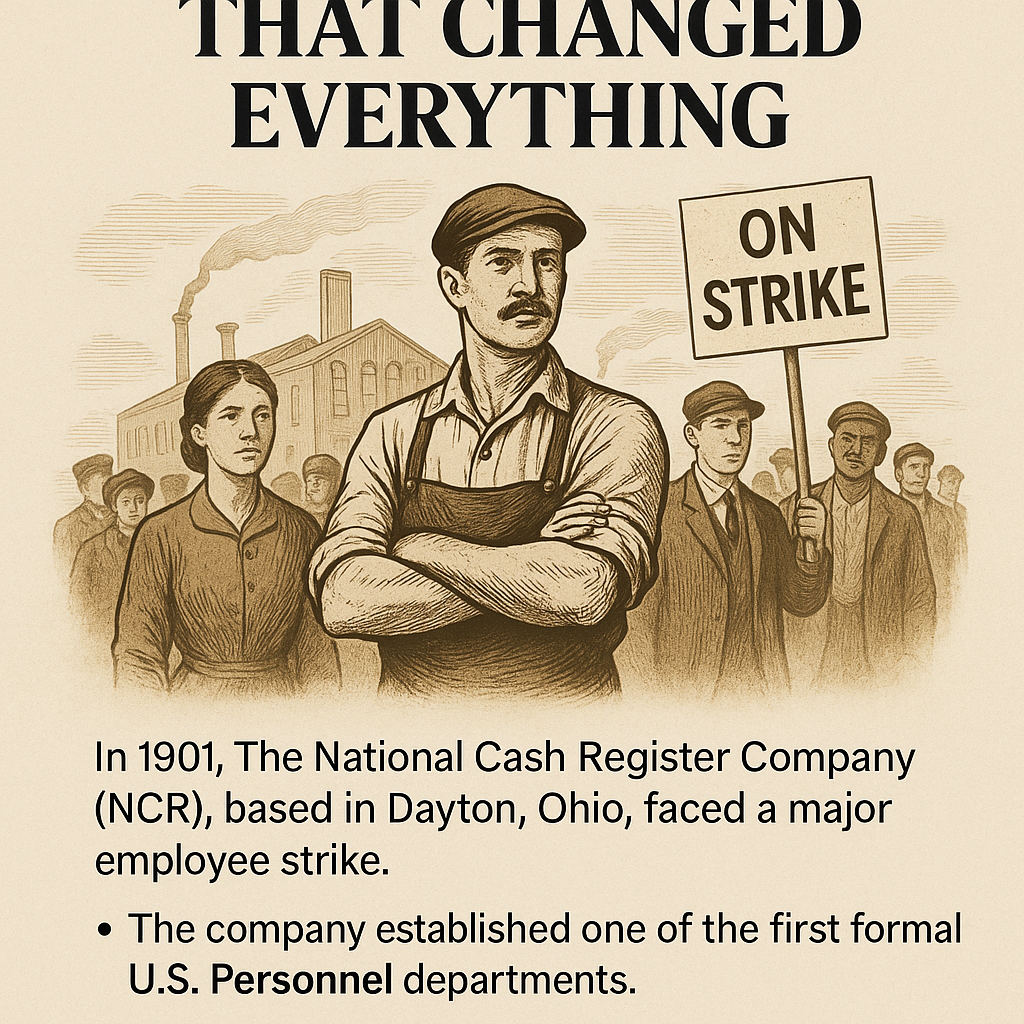
In 1901, The National Cash Register Company (NCR), based in Dayton, Ohio, faced a major employee strike that disrupted business and exposed deep rifts between workers and management.
At the time, there were no standard policies to address employee grievances, no centralized function for hiring or training, and certainly no neutral party to resolve disputes. But instead of doubling down on punishment or union-busting, NCR took a different route—one that would shape workplace history.
The company created one of the first formal Personnel departments in the U.S. Its purpose? To handle hiring, training, employee concerns, and workplace conflicts in a more structured, impartial, and professional way.
 Source: Jacoby, Sanford. Employing Bureaucracy: Managers, Unions, and the Transformation of Work in American Industry, 1900–1945
Source: Bruce Kaufman. The Origins & Evolution of the Field of Industrial Relations in the U.S. (2004)
From Personnel to HR: A Shift in Priorities
Over time, these early Personnel departments evolved into what we now call Human Resources. But as businesses scaled and HR became more integrated with corporate leadership, a shift occurred.
- Personnel departments were originally seen as bridges between workers and management.
- Modern HR departments are often viewed as enforcers of company policy, focused more on protecting the business than advocating for employees.
In fact, surveys consistently show that most employees don’t trust their HR departments to have their back. A 2022 report by BambooHR revealed that 70% of employees believe HR prioritizes the company over the individual.
So, what happened to that impartial, worker-focused mission NCR first imagined?
the411HR: Returning to America’s HR Roots
At the411HR, we’re reclaiming the original purpose of the Personnel department—to provide a trusted, unbiased support system for employees navigating their rights, workplace issues, and career questions.
Just like NCR realized in 1901, employees need:
- A place to turn when things go wrong
- Guidance that’s not filtered through management’s interests
- Professional, confidential support on their rights and options
That’s what we offer.
We’re not corporate HR. We’re employee HR.
We help people navigate everything from toxic management and retaliation, to family leave confusion, wage issues, and ADA or FMLA questions. We don’t answer to employers—we answer to employees.
And that difference changes everything.
From 1901 to Today: The Fight for Fair Treatment Isn’t Over
The creation of NCR’s Personnel department over a century ago was a turning point in U.S. labor history. It recognized something that still holds true:
 When employees are heard, supported, and treated fairly—everyone wins.
But in today’s workplace, that balance is often lost.
That’s why the411HR exists—to restore trust, accountability, and fairness in the employer-employee relationship. We carry forward the spirit of those early reforms, not with nostalgia, but with purpose.
Because it’s time HR remembered what—and who—it was really created for.
 Learn more at the411HR.com
 Confidential Employee HR Hotline: 609-200-6096
 Follow us @the411HR on Instagram & Facebook
References
- Jacoby, S. (1985). Employing Bureaucracy: Managers, Unions, and the Transformation of Work in American Industry, 1900–1945
- Kaufman, B. (2004). The Origins & Evolution of the Field of Industrial Relations in the U.S.
- BambooHR. (2022). “Do Employees Trust HR?”
- SHRM. (2021). A Brief History of HR in America
- Encyclopaedia Britannica: “National Cash Register Company” Link